
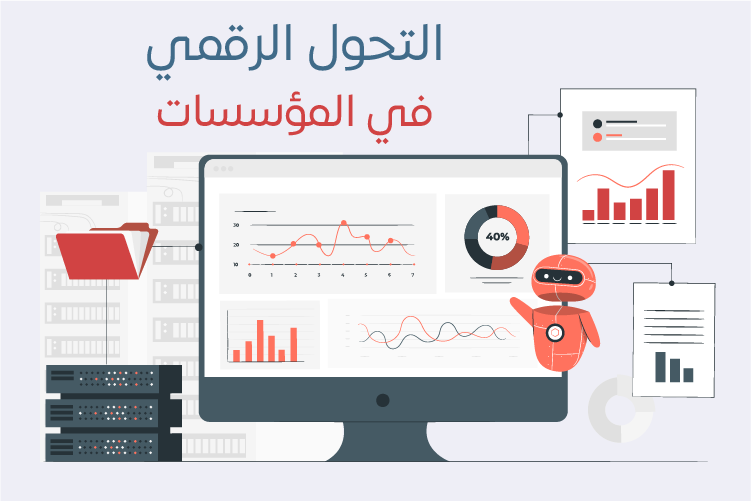
Digital Transformation in Organizations
Digital technologies are creating new opportunities for organizations around the world by reshaping how goods and services are produced, sold, and consumed. As services and products continue to evolve at a rapid pace, digital transformation has become a fundamental requirement for keeping up with technological advancement in the business world. These technologies enable organizations to adapt to competitive pressures, meet evolving customer needs, and align with the digital era. As a result, digital transformation has become a necessary and secure pathway for many companies seeking to enhance their services, attract more customers, and increase their share in a highly competitive market.
So, what is “digital transformation”? How does it differ from “digitization”? Where does its importance lie? What are its fields? And does it have challenges as well as advantages?
What Is Digital Transformation?
Digital Transformation is a cultural shift that requires organizations to integrate digital technology across all areas of business, leading to fundamental changes in how companies operate through a radical transformation of their structure. It involves redesigning business processes by relying on digital technologies to convert traditional manual operations into digital ones, or replacing outdated digital technologies with more advanced and modern solutions.
In essence, digital transformation represents all efforts aimed at converting traditional work methods and strategies into a fully integrated digital work environment through the use of advanced technological solutions.
How Did Digital Transformation Begin?
With the advent of the World Wide Web across various aspects of our lives, the scope, speed, and impact of digitization changed fundamentally, increasing pressure for societal transformation. As the new millennium began, digitization expanded on a large scale, leading to widespread use of the internet and information technology at all levels—reaching comprehensive governmental adoption of IT systems. This was accompanied by parallel developments in the broader business environment, increasing awareness of digital transformation and the opportunities it offers.
As digitization continued to permeate the business world, the concept of digital transformation emerged as a comprehensive alternative capable of meeting accelerating digital developments year after year.
What Is the Difference Between Digitization and Digital Transformation?
Digitization is the process of converting physical aspects of business operations (such as printed records) into digital formats that can be stored and processed easily by computers.
Digital transformation, on the other hand, encompasses all processes that use and process data digitally to generate value for business and beyond. It has a much broader scope and leads to a comprehensive cultural shift within an organization.
Accordingly, digitization can be considered the first step in the broader journey of full digital transformation.
Why Is Digital Transformation Important?
According to Deloitte, digital transformation is more about technology strategy than technology itself. To remain competitive, organizations must pay close attention to building a strong, well-thought-out digital strategy. Digital transformation goes beyond traditional functions such as sales, marketing, and customer service; instead, it begins and ends with how you think about customers and how you engage with them using modern, advanced digital strategies.
Pillars and Areas of Digital Transformation
Digital transformation primarily relies on the following elements: employee empowerment, customer engagement, process optimization, product transformation, innovation, operational agility, culture and leadership, and digital technology integration, among others.
Its scope is not limited to companies that sell digital products. It affects all sectors and departments—from traditionally conservative institutions such as healthcare and education, to hospitality and tourism, e-commerce, banking, training and skills development, supply chains, governance, and businesses focused on software and application development.
Advantages of Digital Transformation
Digital transformation offers numerous benefits, including:
-
Stronger resource management
-
Leveraging technology to better understand and manage business operations
-
Reduced operational costs
-
Added value to every customer interaction
-
Increased organizational agility
-
Enhanced data collection
-
Data-driven customer insights
-
Improved customer experience
-
Higher productivity and increased profitability
Challenges of Digital Transformation
Any company planning to undergo digital transformation must be fully aware of potential challenges in order to overcome them successfully.
The process is not as seamless as it may appear. Key challenges include:
- Resistance from managers who adhere to traditional work methods and find change difficult. Despite their experience and loyalty, transformation may cause discomfort, confusion, or fear of reduced competitiveness.
- Insufficient employee readiness and training. Digital transformation is not merely about installing hardware and software; it depends on how employees interact with systems, adapt over time, and overcome challenges—especially during the transition phase.
- Lack of collaboration and participation, even though digital transformation is built on teamwork and shared innovation aligned with market needs.
- Limited financial resources, as digital transformation can be costly and technically demanding.
When reviewing these challenges, it becomes clear that most (except for financial constraints) are human and behavioral rather than technical.
Therefore, leadership roles, internal relationships, motivation, reassurance, and effective communication are all essential components of successful digital transformation equally as important as modern systems, applications, and technologies.
This is precisely what Time24 prioritizes with its clients: providing administrative support, leadership consulting, and strengthening internal communication throughout the organization aligned in parallel with every stage of the digital transformation process.
Contact us today to schedule a meeting with our team and begin building a successful digital transformation journey for your organization.


